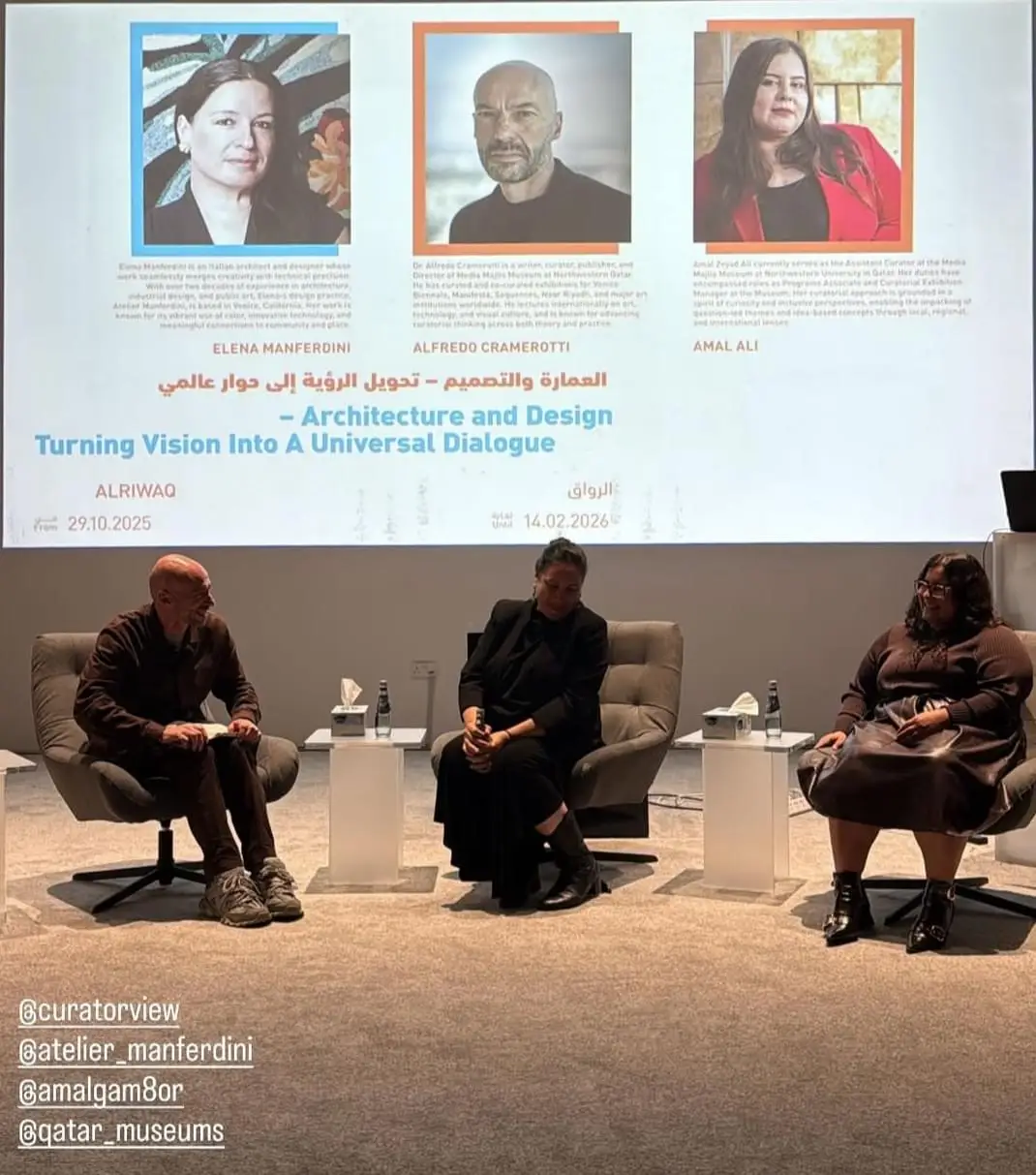
The impact of AI on design and architectural practice by Elena Manferdini, Alfredo Cramerotti, Amal Ali. Part of Architecture and Design - Turning Visions Into A Universal Dialogue public program of Qatar Museums - Al Riwaq
Manferdini's talk, Something Old, Something New, Something Borrowed, Something Blue, examines the impact of AI on design and architectural practice through Atelier Manferdini’s 2025–26 Rome Opera House project. The lecture addresses questions of originality, identity, and authorship in the age of intelligent systems, using AI-driven visualizations to explore themes of beauty, spectacle, and societal constraint.
Following the talk, a three-way conversation between Manferdini, Cramerotti and Ali addresses the fact that AI is everywhere—reshaping how we live, work, and create. This panel examines the current role of AI in contemporary design and architectural creative practice, using Atelier Manferdini’s work for the 2025–26 season of the Rome Opera House as a case study; it further explores whether—and how—AI can produce something truly new, while also raising questions abound identity, authorship, and the evolving role of the designer in the age of intelligent systems.
Points for the discussion:
AI as Co-Designer: The Ethics of Machine Creativity
Based on Manferdini’s lecture “Something Old, Something New, Something Borrowed, Something Blue.”
Elena Manferdini: reflections on La Traviata project for Teatro dell’Opera di Roma — how AI visualized the duality of spectacle and confinement.
Amal Ali: perspectives on cultural production in the Gulf and the tension between tradition and technological innovation.
Cramerotti: connecting to his notion of hyper-imaging — images and forms that do not represent but actualize, performing reality through data and perception.
Key discussion terms:
Authorship – who “owns” the creative act in AI-assisted architecture?
Training sets as culture – how biases embedded in AI shape design aesthetics.
Machine vision – the new optics of architectural imagination.
Questions to unpack:
Can AI truly “design,” or does it only remix historical data?
How can designers maintain authorship and ethical control while co-creating with intelligent systems?
Is there a risk of losing “human error,” the productive friction of imperfection?
The Spectral Condition: Between Tradition and Algorithm
Connecting both lectures thematically.
Manferdini’s metaphor of the spectrum as a continuum — from material pigment to immaterial data.
Amal Ali: reinterpreting tradition through digital craftsmanship in Gulf architecture and art.
Cramerotti: from colour to code, how the architectural discipline becomes a cultural interface mediating past and future.
Key terms:
Spectral aesthetics – the coexistence of analog and digital layers.
Borrowed forms – architectural sampling and algorithmic heritage.
Affective geometry – emotion embedded in computational design.
Follow-up questions to unpack:
What remains “human” in the spectral blend of machine and mind?
Can digital tools help us rediscover, rather than erase, local narratives?
How do emotional and sensorial responses persist in computationally generated environments?