Sougwen Chung: BODY MACHINE (MERIDIANS) [curating, art management]
23 Apr 2026 – 14 Jul 2026
Details of Exhibition
Sougwen Chung is an artist and researcher known internationally for working at the intersection of drawing, performance, robotics, and artificial intelligence. Over the past decade, Chung has developed systems focusing on human-machine collaboration.
In earlier projects called D.O.U.G., short for Drawing Operations Unit: Generation, Chung trained a robotic system using their own personal drawing movements. allowing them to learn from their gestures. Chung has performed live alongside machines that respond to them in real time, creating artworks together through motion and feedback. Chung’s practice combines coding, choreography, data collection, and embodied experimentation.
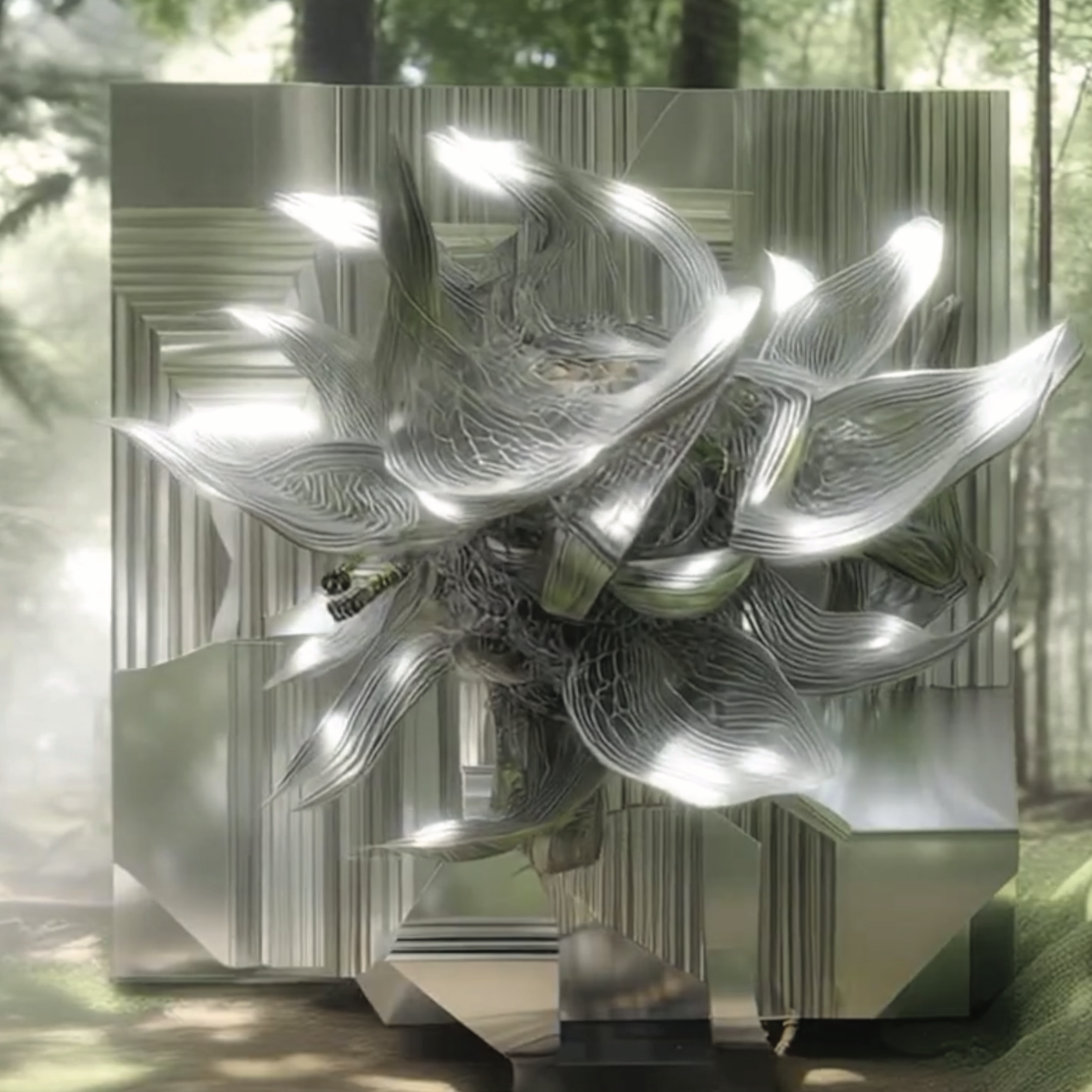
For BODY MACHINE (MERIDIANS), Chung expands this research into a large-scale environment. The installation brings together movement data from their own body, environmental recordings, machine learning systems, and immersive sound design. The result is a living system of light, sound, and motion. BODY MACHINE (MERIDIANS) is a series of biomimetic, meaning life-inspired, speculations. The forms you see are generated digitally, but they feel organic. They are shaped not from stone or metal, but from air, light, and data.
Chung imagines machines as extensions of living systems, the digital forms are sculpted in space through gesture, sound, and algorithmic processes. They appear, transform, and disappear, behave more like weather patterns or currents than objects and at the center of the work is the idea of the “meridian.” A meridian can mean different things: a planetary line used to measure the Earth, a pathway in the human body through which energy flows and a symbolic connection between distant points.
By bringing these meanings together, Chun invites us to think about connections across scales: between the human body, technological systems, and the planet itself. Bodies in motion, machine intelligence, and Earth’s ecosystems are presented as interconnected processes. Today, artificial intelligence is often described in terms of speed, automation, and efficiency. In contrast, BODY MACHINE (MERIDIANS) proposes another possibility.
Sougwen Chung often speaks of Relational Intelligence, and more recently of Operational Art, where the machine is more a deep collaborator. This idea resonates with the philosophy of Gilbert Simondon, who argued that machines are not isolated objects but evolving entities shaped by relationships, with humans, environments, and culture. For Simondon, technology develops through interaction, not domination and Chung’s work brings this philosophy into practice. The system responds to gesture, sound, and environmental data, It adapts, It transforms, It participates. Rather than asking how machines can replace humans, the work asks: how can humans and machines co-evolve?
Within the larger installation, one chapter focuses on water and ice. For this project, Chung undertook an Arctic expedition. They scanned melting glaciers, recorded the changing light of the polar sun, and immersed themself physically in icy waters, spending five minutes fully submerged in glacial melt at 0.2°C, feeling the unending polar sun and calving glaciers alter the temperature of the water around their body. As symbolic gestures and research methods, they were acts of radical attunement, an oscillation between collective and environmental bodies, states of solidity, suspension, and swell. Movement data from their body, shaped by cold and resistance, became part of the installation’s digital language. And more important the glacier becomes a temporal system and not just a sign of climate crisis.
Glaciers move slowly, over centuries, their melting is both loss and transformation. The French philosopher Henri Bergson described time as durée, continuous lived duration. The glacier embodies this idea: it changes gradually, yet constantly. In the installation, flowing and melting are environmental processes and metaphors for how data, bodies, and perception transform. Chung’s practice is deeply embodied. The movement data used in BODY MACHINE (MERIDIANS) comes from their own gestures. When Chung moves, the system learns. When Chung draws, the machine responds and in this case the body became a source of knowledge. This understanding echoes the philosophy of Maurice Merleau-Ponty, who wrote
that the body is not an object we possess, but the means through which we experience the world. From the perspective of Taoist philosophy, the body is alsounderstood as a field of energy. In the Dao De Jing, attributed to Laozi, water is described as the highest model of intelligence: it adapts, yields, yet persists. Energy, or qi, flows through meridians that connect internal organs to the external world. In Chung’s work, bodily meridians align metaphorically with planetary meridians and digital data flows. Energy circulates between human gesture, machine response, and environmental systems. Nothing is isolated, everything moves.
Chung’s work continues a long artistic exploration of movement and light. In the early twentieth century, László Moholy-Nagy experimented with kinetic sculpture and light projections that dissolved solid form into motion. Later, cybernetic artists such as Nicolas Schöffer created responsive environments that changed according to external inputs. Today, instead of mechanical systems, Chung works with machine learning and sensor-based technologies. But the question remains similar: can an artwork behave like a living system?
Installed within the historic architecture of Palazzo Citterio, the work introduces multiple layers of time: architectural time, planetary time, bodily time, and computational time. The LED wall becomes less a screen and more a membrane, a surface through which light, sound, and information circulate. The installation does not overwhelm through spectacle. Instead, it invites slowing down. It encourages viewers to attune themselves to subtle shifts of rhythm and energy.
Ultimately, BODY MACHINE (MERIDIANS) proposes a simple but profound shift:
From control to correspondence.
From extraction to reciprocity.
From automation to collaboration.
It suggests that imagining new technological futures begins with deeper listening.
And the concept of faster machines are not part of the picture anymore.