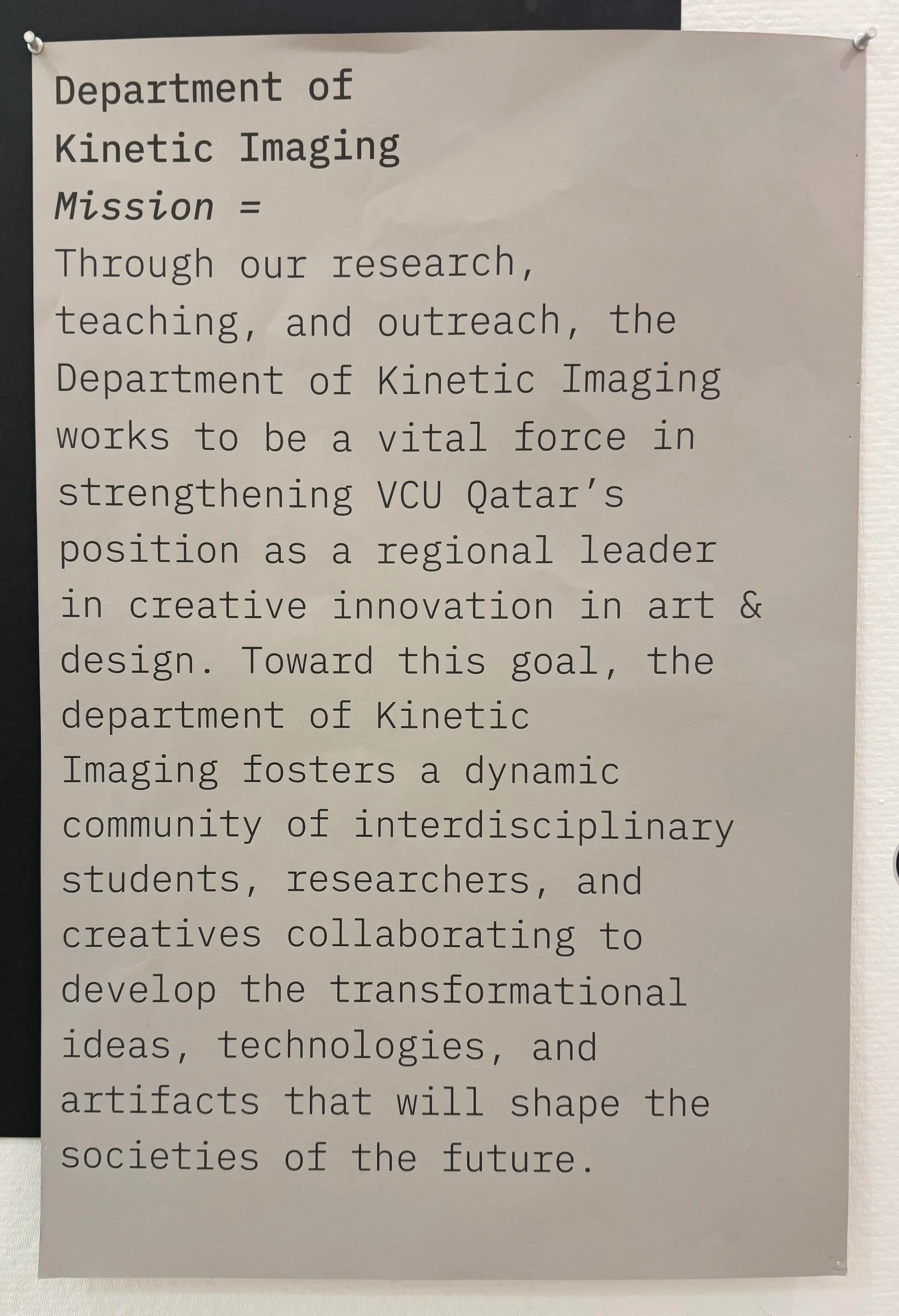
Critical Issues in Media — AI, Power, and the Future of Artistic Practice. Lecture by Auronda Scalera & Dr. Alfredo Cramerotti for Kinetic Imaging @ VCUArts Virginia Commonwealth University School of the Arts in Qatar
Overview of the talk:
How AI technologies impact artistic production, distribution, and exhibition-making
Case studies from our curatorial practice using advanced technologies
Ethical implications, bias, authorship, environmental cost, within the context of art and media
Eventual new models of artistic agency
The lecture develops through four critical enquiries:
PART I: AI REALLY?
AI as Cultural System
How datasets encode aesthetics: who decides what images look like?
AI-generated art as a “mirror of our archives” (Florencia Bruck) https://www.instagram.com/p/C1IgU4PNsyf/
Implications for Art & Media
Shift in role of the artist: author, director, dataset designer
Curatorial responsibility: transparency, disclosure, ethics
AI and Global South narratives: underrepresented datasets, aesthetic stereotypes, misidentification
(memes exhibition or Linda Dounia)Linda Dounia Senegalese artist who critiques large foundational AI models (like DALL-E, Midjourney) for their biased depiction of the Global South. She builds her own datasets (of historical buildings, indigenous flora) and uses GANs to generate new imagery. Example project: Once Upon a Flower: imagines a future where climate change has killed real flowers, replaced by AI-simulated ones. https://openfuture.eu/wp-content/uploads/2024/03/240328_Your_Art_plus_AI.pdf
https://lindarebeiz.com/
PART II: CURATORIAL PRACTICE
Case studies from our practice that connect art + emerging technologies
PART III: THE GCC CONTEXT
How is AI shaping cultural production in the Gulf?
What does digital sovereignty mean in a region of rapid technological growth?
Can AI amplify regional narratives or does it risk flattening them?
How do we design ethical and sustainable digital futures within the GCC?
PART IV: FUTURE DIRECTIONS & UNRESOLVED QUESTIONS
Emerging points:
Post-AI aesthetics: when humans emulate machine styles
Copyright, royalties, and dataset provenance
Emotional AI + affective computing in museums
Digital ownership, blockchain, and governance
The curator as a “translator” between human and machine cultures