AIM Inundated, Imagining Life After Land – Nauru Pavilion at the 61st Venice Biennale of Contemporary Art [artistic practice]
9 May 2026 – 22 Nov 2026
Details of Exhibition
From Colonial Extractivism to Universal Warning and Guide
Presenting ecological precarity not as a distant horizon, but as an ongoing condition, the Pavilion acknowledges Nauru as a place where the long-termconsequences of global economic and political decisions have been materially lived, and thresholds have already been crossed, and so reframes it from being a remote or marginal territory to become both a universal warning and a crucial guide for a shared future.
Situated at the convergence of rising sea levels, environmental exhaustion, and the enduring legacies of colonial extractivism, Nauru stands as one of the most impacted sites. The present moment of Nauru cannot be divorced from its extractive history. Decades of intensive phosphate mining transformed the island’s landscape and economy, leaving behind a terrain marked by ecological depletion, compromised sovereignty, and geopolitical marginalization. It demonstrates how resource demand can dismantle both ecological and socio-cultural systems, and how environmental loss is systematically produced through global systems of extraction, governance, and uneven responsibility.
The Pavilion looks at Nauru as both a specific territory and an emblem of planetary transformation. It is a conceptual study of disappearance resisting spectacle and catastrophe imagery, and understanding it not only in terms of physical land loss but also as the erosion of cultural continuity, ecological knowledge, systems of meaning, and political agency. Through this lens, inundation becomes a framework for examining how environmental change reconfigures identity, memory, nationhood, and sovereignty, while also reshaping the parameters through which futures are imagined.
Archipelagic Thinking
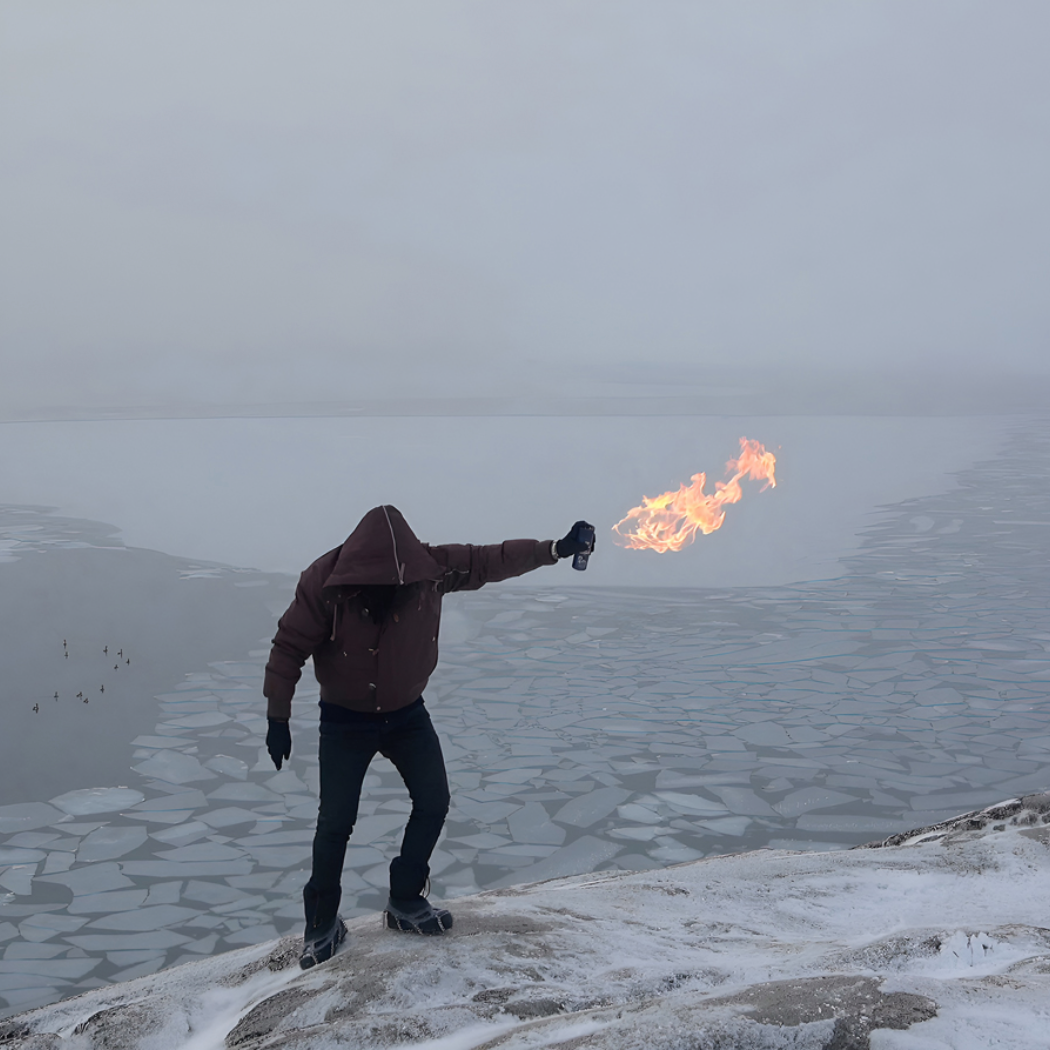
Structured through archipelagic thinking, the Pavilion assembles a constellation of visions. The ten invited artists belong to different nations and generations, and their works range from installation, video, painting, photography, sound, text, documentary, research, and the use of artificial intelligence. The exhibition takes its cue from the harsh and sincere lyrics of a song by Kauw Tsitsi (Nauru, 1995), which says, “Trapped in the weight of someone else’s wealth… The soil remembers every cut… We were more than a resource, more than a deal… This island breathed before the drills, before progress learned how to kill.” In the epic video We Are All Nauru, Stefano Cagol (Italy, 1969) moves between Greenland, Kyrgyzstan, and Texas, staging symbolic acts of environmental violence, resource hunger, and supremacy as exorcisms. He then presents a critical update of The Ice Monolith in public spaces during the Biennale opening days. The installation Sea that Remembers by Tedo Rekhviashvili (Georgia, 1990) bridges the boundaries between painting, sculpture, and sound, using the shell as a symbol of home amidst collective traumas and individual mythologies. Patricia Jacomella Bonola (Switzerland, 1952) exhibits I Used to Go to the Beach, a sail composed of fragments, a symbol of resistance to adverse forces and synergy. Ron Laboray (USA, 1970) creates visual overlaps and collisions between Western and non-Western systems of meaning, scientific classification, myths, pop culture, and indigenous identities. The exhibition continues with the contributions of Sylvia Grace Borda, Khaled Hafez, CPS, Dorian Batycka, and Iv Toshain.
Beyond the Pavilion
The Pavilion is accompanied by performances, seminars, international satellite events, and a publication, reinforcing the Pavilion’s role and positioning Nauru as an active contributor to the global cultural and ecological discourse.
Image: Stefano Cagol, We Are All Nauru, 2024-2025